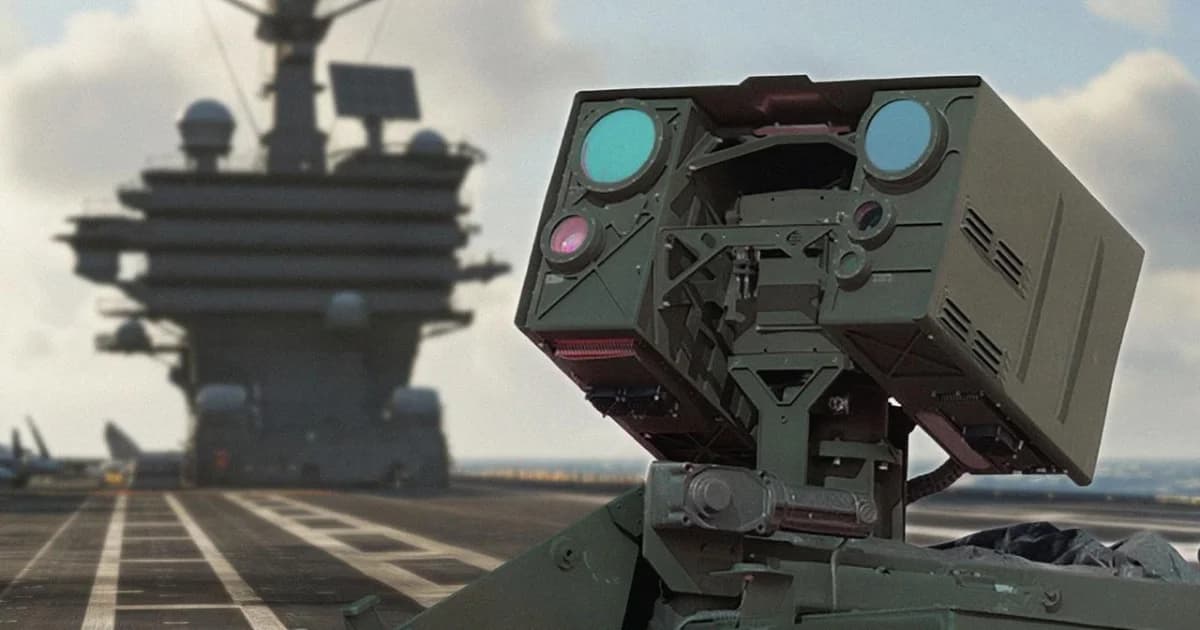
For a single day at sea, AeroVironment’s palletized LOCUST laser weapon system was forklifted onto the flight deck, enabling a live-fire exercise that demonstrated its performance in real-world operational conditions. The system was powered from the ship, operated by sailors with less than an hour of training, and engaged every target presented. Every single target was destroyed.
The rapid laser weapon test was conducted in October 2025 aboard the nuclear-powered aircraft carrier USS George H.W. Bush (CVN-77). For the Navy, it was a first look at what the company’s containerized, “roll‑on/roll‑off” laser weapon, LOCUST, can really do.
AeroVironment’s laser weapon
When most people picture a shipboard laser weapon, they likely imagine a massive, bulky system—welded into the hull and fixed in place. That’s not what the company brought aboard USS George H.W. Bush.
The Navy’s early laser efforts focused on high‑power systems integrated into the ship, hard‑wired into the hull and power system. Those programs taught the parties involved a lot, but they also revealed constraints: if the ship goes into maintenance, the weapon does too; if the laser needs upgrades, the work around the ship; moving capability between hulls is slow and costly.
Meanwhile, counter‑UAS is becoming a daily operational problem. The Army had proven that palletized, truck‑mounted lasers could consistently defeat small drones in harsh environments. The natural question was: could that same modular, field‑ready architecture work at sea?
AeroVironment’s efforts
The LOCUST variant used on USS Bush was built on its Army-fielded design, but carrier life demands more, like hardened electronics for salt fog, humidity, vibration, and long deployments. It also needs stabilization hardware to manage ship motion, and sealing and environmental protection so the system would be ready whenever it was needed.
On USS Bush, LOCUST was forklifted onto the flight deck in palletized form, positioned in a location that required pausing normal flight operations during the test window. It was forklifted back off once the demonstration ended so the carrier could resume its standard tempo.
For the Navy, the USS Bush demonstration answered key questions that need to be addressed as technology transitions from labs to the field. Most important of all, the demo showed that a containerized laser weapon can operate effectively from a carrier without being permanently integrated into the ship. The demo also showed the Navy that training for these new systems can be straight forward and quickly implemented for sailors.